Sunday morning, August 9, the vendors at Flagler Park were breaking down their tables by 1 p.m., right as Cover to Cover Band started setting up gear on the Riverwalk Stage a few blocks away. That overlap happens every week now, farmers market winding down as the free concert series takes over, and it's the kind of rhythm you stop noticing after a while. What you can't stop noticing this month is the orange construction fencing running along the courtesy dock, where a crew has been rebuilding the city's public boat slips since early July.
Those two things, the fencing and the paperwork sitting in a federal registry three states away, are the same story. Downtown Stuart is getting physically bigger on the water at the exact moment it's getting legally locked in on land. One project adds capacity. The other freezes character in place. Both are happening on the same six or seven blocks, in the same season, and neither one is waiting for the other to finish.
The Dock Got Serious in July
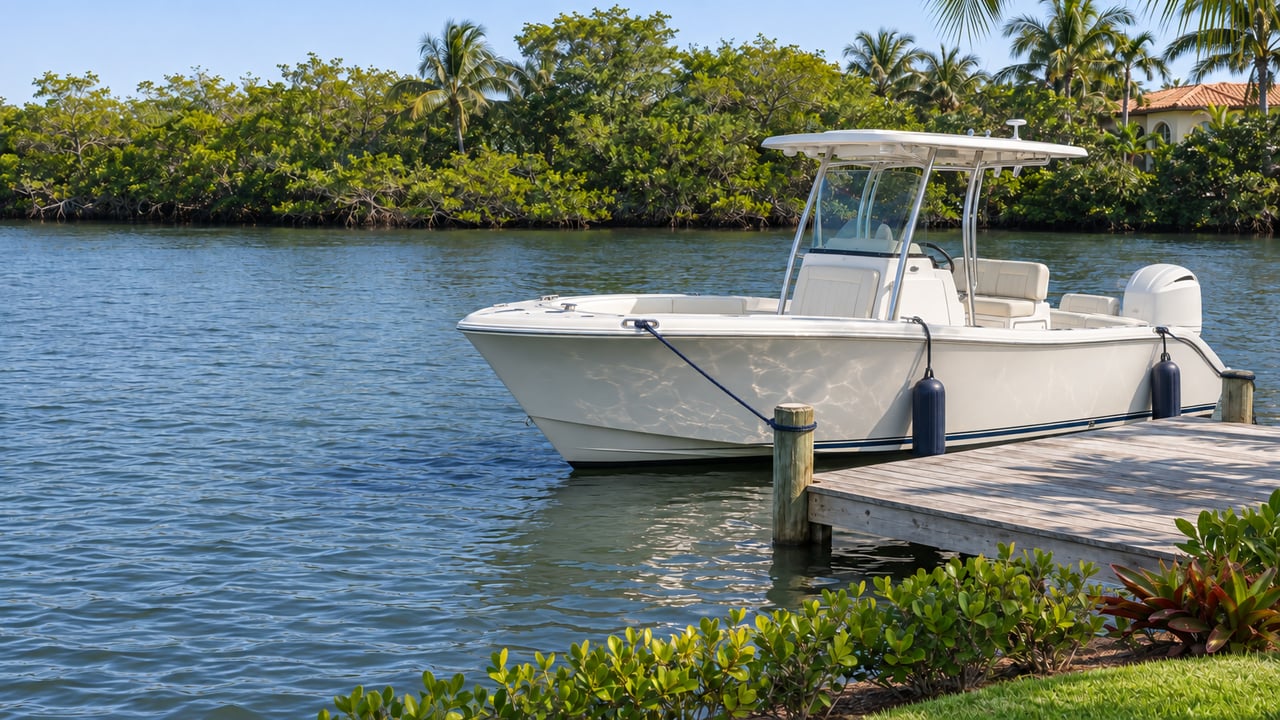
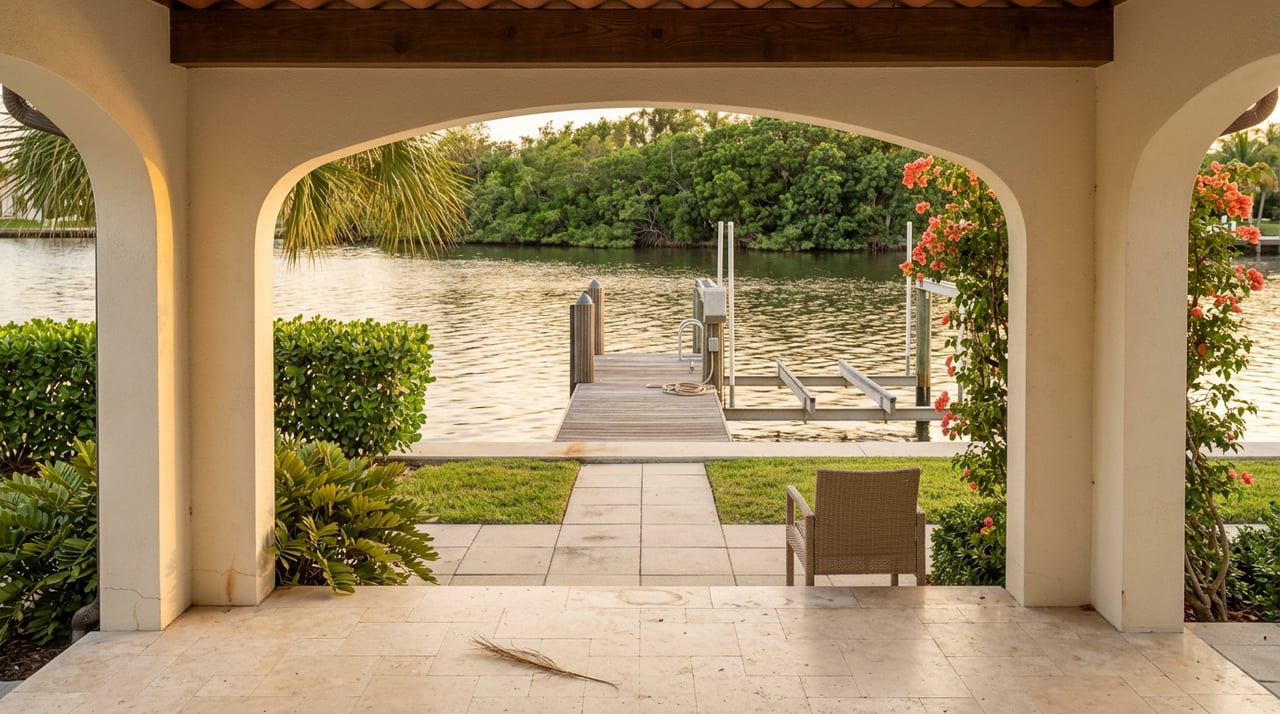
The City of Stuart's public courtesy dock, the free tie-up spot that's let visiting boaters walk into downtown restaurants and shops for years, has been running at 18 slips packed into a 5,533-square-foot floating structure. Construction on its replacement began July 6, 2026, and when it's done the dock will hold 44 slips, a marina-style layout built for durability rather than the aging floating pontoons it's replacing.
| Current Dock | Under Construction | |
|---|---|---|
| Slips | 18 | 44 |
| Structure | 5,533-sq-ft floating dock | Fixed, marina-style layout |
| Boaters served per year | About 1,450 | Expected to grow |
| Construction start | — | July 6, 2026 |
That's not a modest upgrade. It's more than double the tie-up space on a stretch of waterfront that already draws close to 1,450 boaters a year by the city's own count. If you've eaten at a table with a river view downtown, some of those boats tied up within walking distance of your dinner. There are going to be a lot more of them once the work wraps.
The Blocks Around It Just Got a Preservation Label
While that construction was getting underway, a different kind of change was moving through a much slower pipeline. On May 11, 2026, the City announced that both the Downtown Stuart Historic District and the East Stuart Historic District had cleared the Florida National Register Review Board and were headed to the National Park Service for final listing. By July 10, 2026, both had appeared in the Federal Register, with formal boundaries attached: Downtown Stuart runs along SW Flagler Avenue, the St. Lucie River, SE Denver Avenue, and Flagler Park, and East Stuart is bounded by Martin Luther King Boulevard, 10th Street, Tarpon Avenue, and the FEC Railway tracks.
Commissioner Eula Clarke put it simply when the city made the announcement, saying the two districts "tell the story of resilience, culture, and community pride." That's not just civic language. East Stuart began in 1913 as Lincoln Park, the only neighborhood in the area where Black residents were permitted to live, work, and worship under the segregation laws of the time. The Stuart Training School, a Rosenwald Fund school that operated there until 1964, is one of the reasons the district qualified. It's the kind of building a National Register listing exists to protect.
What that listing actually changes for someone walking those blocks is narrower than it sounds. What it does is open the door to preservation grants. The City's own land development code already requires a 30-day waiting period before any surveyed historic structure downtown can be demolished.
Two projects, same season, opposite instincts. One is pouring concrete to hold more boats. The other is filing paperwork to make sure the buildings those boaters walk past don't disappear. They don't compete for the same resource, which is probably why nobody's had to choose between them. One lives on the water. The other lives on the sidewalks.
What Sunday Actually Sounds Like Right Now
If you want to see both stories in the same afternoon, Sunday still works. The Downtown Stuart Farmers Market runs at Flagler Park starting at 9 a.m., and Rock'n Riverwalk takes the stage at 1 p.m., free, funded entirely by donations and sponsors and presented jointly by Stuart Main Street and the Historic Stuart Downtown Business Association. The lineup keeps rotating: Cover to Cover Band played August 9, Johnny Floor & The Wrong is booked for August 16.
The free historic trams are still running their usual loop too, seven days a week, stopping at Haney Circle and Flagler Park among other spots. With dock construction narrowing some of the waterfront walking paths, the tram is turning into a more useful way to get from a downtown parking spot to a restaurant table than it was a year ago.
The Restaurant List Got Longer While the Facades Got Locked In
The dining scene downtown hasn't slowed down for any of this. Waterfront, the two-story spot with sweeping river views, took over the building that used to house Mulligan's, a project co-owners Derik Shambaugh and James Corrigan built out to 12,000 square feet with a casual lounge downstairs and a more polished dining room up top. A few blocks over, Mai Tiki settled into the Old Colorado Inn under Chef Doug Forgione, serving Florida wahoo and shrimp scampi in an open-air setting that leans into the building's history rather than covering it up.
The rest of the current lineup reads like a map of what's opened or gotten louder in the last year or two:
- CoLab Kitchen, farm-to-table with a patio built for groups
- Oak and Ember Steakhouse, right in the heart of downtown
- Stack Burger & Bourbon, built around premium, locally sourced beef
- The Gafford, named for the owners' grandparents, known for a signature ribeye
- TideHouse, second-floor river views from Safe Harborage Marina
Most of those sit within a few minutes' walk of the courtesy dock. When that dock finishes going from 18 slips to 44, the restaurants closest to the water are the ones positioned to feel it first. More boats tying up downtown means more people walking in for lunch who arrived by water instead of by car, and it's happening in buildings that are worth walking to in the first place.
That's the actual shape of downtown Stuart this summer. It's not choosing between growth and preservation. It's running both at once, on the same blocks, and betting that a bigger dock and a protected streetscape make each other more valuable rather than less.
If you're already calling Stuart home and you're curious what any of this means for what your property is worth, Julie Cline has spent more than two decades watching how changes like these play out on Martin County's waterfront. Get Your Instant Home Valuation whenever you're ready to see where things stand.
This article is general information, not legal, tax or financial advice. Consult a qualified professional about your situation.